

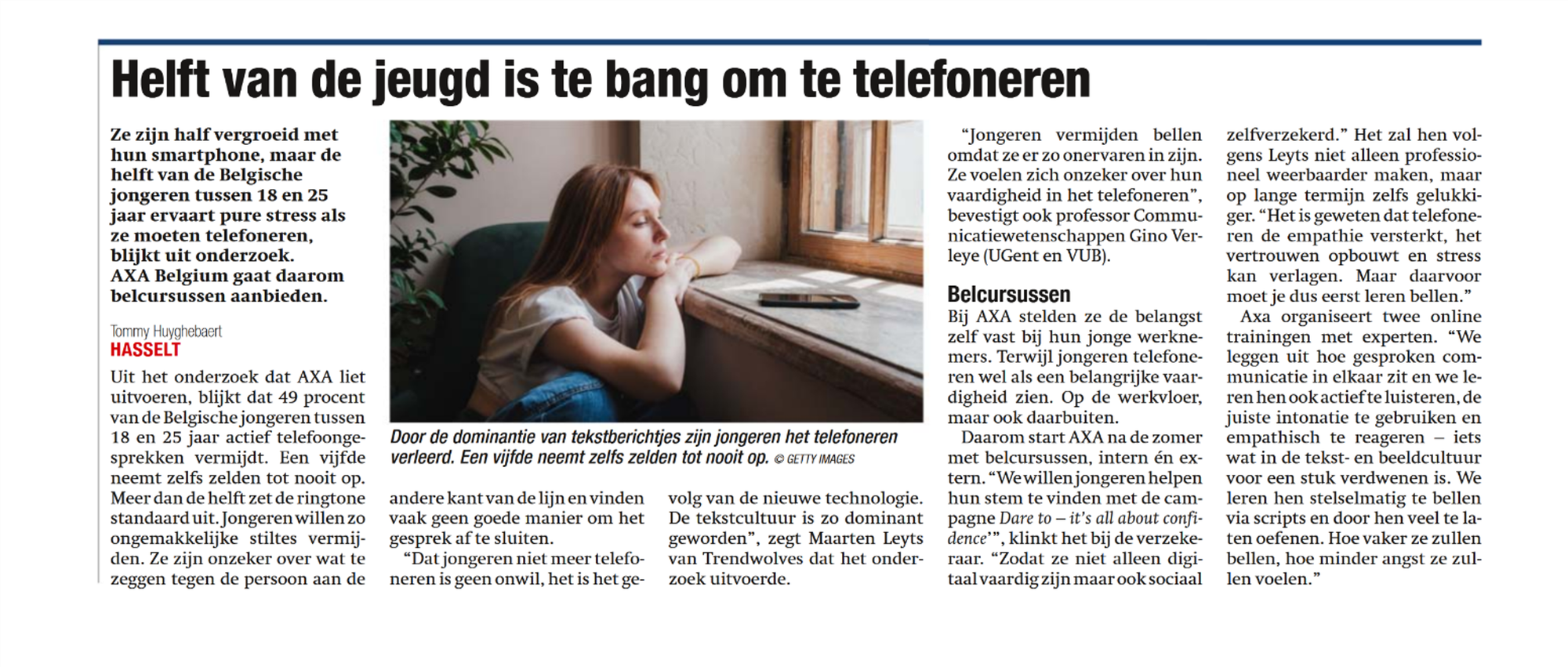
But communication is anything but simple. Especially when you consider how different generations handle it. As the article “Half of the youth is too afraid to make phone calls” shows, nearly half of Belgian young people aged 18 to 25 experience stress when calling. They actively avoid it, feel insecure and inexperienced.
The generational timeline: from Boomers to Gen Z
There are clear differences in communication style:- Boomers (1940-1955) are accustomed to personal contact and telephone as the primary channel.- - Generation
X (1955-1970) effortlessly switches between analog and digital.
- - Millennials (1980-1995)
are digitally skilled but appreciate context and nuance.
- - Gen
Z (1995-2010) communicates quickly, visually, and asynchronously, and
avoids calling if possible.
These differences are not an obstacle but an opportunity. Because if we use communication generatively, as something that gives energy, builds trust, and encourages collaboration, we can bridge the gaps between generations.
What does this mean for organizations in the public domain?
Organizations in the public domain face a
challenge:
- - Housing corporations want
to help residents quickly and personally.
- - Municipalities must
be accessible to citizens of all ages.
- - Care institutions deal
with urgent communication, often by phone.
- - Schools communicate
with parents, students, and external partners.
But how do you do that if a part of your target audience prefers messaging over calling? Or if your employees from different generations each have their own preferences?
The solution: generative telephony
At 365 Angels, we help organizations to reshape telephony. With Teams Telephony and Dynamics Contact Center we make calling accessible, contextual, and people-focused. We ensure that employees, both young and old, feel comfortable in their communication. And we help organizations adjust their accessibility to the needs of citizens, customers, and colleagues. Because calling is not dead. It is evolving. And those who embrace this change create connection.